Artificial intelligence has transformed the way people translate content. Tools like Google Translate, DeepL, and AI-powered chatbots are faster and more accessible than ever. As a result, one question is now being asked more frequently than almost any other in the UK translation market: Is AI translation accepted by UK authorities in 2025?
For individuals applying for UK visas, submitting documents to courts, universities, employers, or regulatory bodies, the answer to this question can determine whether an application is approved, delayed, or rejected. In this article, we provide a clear, up-to-date explanation of whether AI-translated documents are accepted by UK authorities, where they are rejected, and how to avoid costly mistakes.
Why This Question Matters More Than Ever in 2025
AI translation tools have improved dramatically in recent years. They are fast, inexpensive, and easily accessible. Many applicants now wonder why they should pay for professional translation when AI seems to “do the job.”
However, UK authorities are not evaluating documents based on convenience. They are evaluating them based on accuracy, accountability, legal validity, and compliance.
In 2025, the number of rejected applications due to improper translation continues to rise—largely because applicants rely on AI or machine translation tools without understanding official requirements.
What UK Authorities Expect From Translated Documents
Before answering whether AI translation is accepted, it is essential to understand what UK authorities actually require.
Most UK institutions expect translations to be:
-
Accurate and complete
-
Professionally prepared
-
Traceable to a responsible translator or agency
-
Certified when required
-
Suitable for legal or official review
AI translation tools cannot meet many of these expectations.
Is AI Translation Accepted by UK Authorities?
The Short Answer
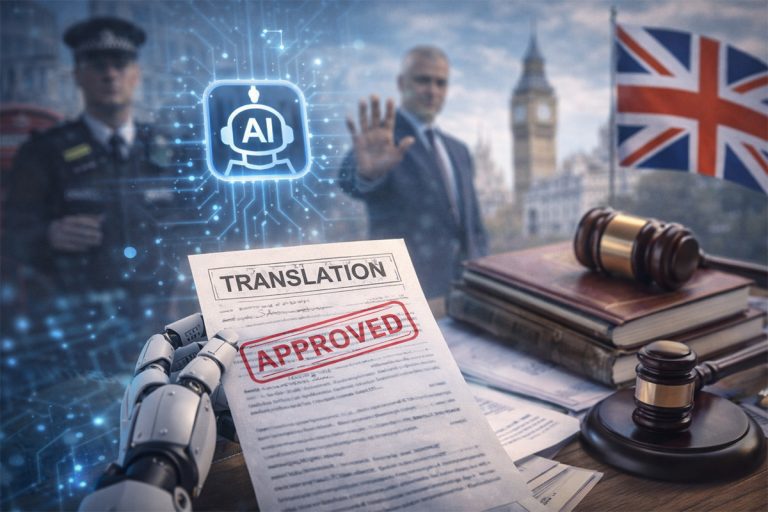
No. AI translation on its own is not accepted by UK authorities for official purposes.
The Long Answer
UK authorities do not explicitly ban AI tools, but they do not accept translations that lack professional certification, accountability, and human verification. Since AI tools cannot provide certification, signatures, or legal responsibility, AI-only translations are usually rejected.
This applies to:
-
UK Visas and Immigration (UKVI)
-
Courts and tribunals
-
Universities
-
NHS and healthcare institutions
-
Employers and regulatory bodies
AI Translation and UK Visa Applications
Immigration is the area where AI-translated documents are rejected most frequently.
UKVI requires that any document not in English or Welsh must be accompanied by a certified translation. This certification must confirm that the translation is accurate and include the translator’s or agency’s details.
AI tools:
-
Cannot certify accuracy
-
Cannot sign declarations
-
Cannot be held accountable
As a result, AI-translated visa documents are almost always rejected.
Can I Use Google Translate for UK Visa Documents?
This is one of the most frequently asked questions in the UK.
No. Google Translate is not accepted for UK visa documents.
Even if the translation appears accurate, it will not meet UKVI’s formal requirements. Applicants who submit AI-translated documents often receive requests for resubmission or face application delays.
AI Translation and Legal Documents in the UK
Legal documents require extreme precision. Courts rely on translations to interpret evidence, contracts, and legal rights.
AI translation tools:
-
Struggle with legal terminology
-
Often misinterpret context
-
Cannot guarantee consistency
Because of this, UK courts do not accept AI-generated translations for legal proceedings.
Professional legal translation services UK are required to ensure accuracy and legal validity.
Medical and Healthcare Documents: Why AI Translation Is Risky
Medical documents involve patient safety, diagnosis, and treatment. Even small translation errors can have serious consequences.
AI translation tools:
-
Misinterpret medical terminology
-
Lack clinical understanding
-
Cannot ensure compliance with healthcare standards
For this reason, AI translation is not accepted for:
-
Medical reports
-
Doctor’s letters
-
NHS documentation
-
Insurance and healthcare claims
Professional medical translation services UK ensure accuracy and confidentiality.
Academic and University Submissions
Universities in the UK require translated academic documents to be accurate and verifiable. AI translations are usually rejected because they:
-
Lack certification
-
Contain inconsistent terminology
-
Do not reflect academic standards
Universities typically request translations from recognised providers or professional agencies.
Business and Corporate Documents
For business registration, contracts, and regulatory filings, AI translation poses serious risks.
AI tools:
-
Do not understand commercial or legal nuance
-
Can introduce ambiguity
-
Cannot provide accountability
Professional business translation services UK help companies avoid compliance issues and reputational damage.
Why UK Authorities Reject AI-Translated Documents
The rejection of AI-translated documents is not about technology—it is about responsibility.
UK authorities require:
-
A named translator or agency
-
A declaration of accuracy
-
Legal accountability
AI tools cannot take responsibility if something goes wrong.
This is one of the most common reasons translations are rejected.
Can AI Be Used at Any Stage of the Translation Process?
Yes—but only in a supporting role.
Some professional translation agencies may use AI-assisted tools as part of their workflow, but:
-
A human translator reviews and edits the content
-
Accuracy is verified
-
Certification is provided by a professional
The final responsibility always lies with a human expert or agency.
Certified Translation vs AI Translation
| Feature | Certified Translation | AI Translation |
|---|---|---|
| Accepted by UK authorities | Yes | No |
| Includes certification | Yes | No |
| Legal accountability | Yes | No |
| Accuracy assurance | High | Inconsistent |
| Suitable for official use | Yes | No |
For official purposes, certified human translation remains essential.
Common Mistakes People Make With AI Translation
-
Submitting AI translations without certification
-
Assuming “good enough” accuracy is acceptable
-
Mixing AI and human translations inconsistently
-
Using AI for legal or medical content
These mistakes often lead to rejection and resubmission costs.
How to Use AI Translation Safely
AI translation can be useful for:
-
Personal understanding
-
Drafting informal content
-
Internal reference
But it should never be used for:
-
Visa applications
-
Legal documents
-
Medical records
-
Official submissions
Why Professional Translation Still Matters in 2025
Despite advances in AI, professional translators offer:
-
Subject-matter expertise
-
Cultural and legal awareness
-
Accountability
-
Compliance with UK standards
Professional translation is not just about language—it is about trust and responsibility.
Why Lanex Does Not Rely on AI-Only Translation
At Lanex, accuracy and compliance come first. While we stay informed about new technologies, we never rely on AI alone for official translations.
Our approach includes:
-
Qualified human translators
-
Industry-specific expertise
-
Full certification
-
Quality control and review
This ensures that documents are accepted by UK authorities without complications.
When to Choose a Professional Translation Agency
You should always choose a professional translation agency in the UK when:
-
Submitting documents to UK authorities
-
Applying for visas or residency
-
Dealing with courts or legal matters
-
Handling medical or healthcare documentation
Final Answer: Is AI Translation Accepted by UK Authorities in 2025?
To be clear:
AI translation is not accepted by UK authorities for official, legal, immigration, medical, or academic purposes in 2025.
AI tools may assist individuals privately, but they cannot replace certified, accountable human translation.
If your documents matter—and they usually do—the safest and most reliable choice is professional translation.
Conclusion: Avoid Rejection by Choosing the Right Translation
AI translation may be fast and free, but it comes with serious risks when used for official purposes. UK authorities require accuracy, certification, and accountability—none of which AI tools can provide on their own.
By working with a trusted provider like Lanex, you ensure that your translations meet UK standards, avoid rejection, and move your application forward with confidence.